



Sleep Apnea and Snoring
May 14th, 2014
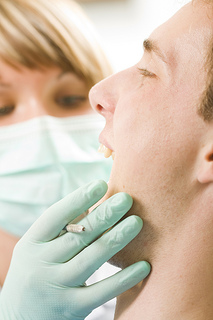
Snoring may not be something you take seriously. You might even laugh or joke about it. But the fact is, anytime you or your partner snore to the point of waking, it could be a sign of serious health problems.
Sleep Apnea and Its Effects
Sleep apnea is a sleep disorder that is potentially dangerous, and the most common symptom is loud snoring. Breathing repeatedly starts and stops throughout the night, and you wake up feeling tired. Other serious effects from sleep apnea could be potentially dangerous to your health if left unaddressed.
Besides losing a good night's sleep, you may experience difficulty concentrating. Depression, risk of heart attack, irritability, high blood pressure, memory loss, sexual dysfunction, and chances of stroke all increase when sleep apnea is not treated.
Sleep apnea occurs when the muscles in the back of the throat relax to the point of inhibiting natural breathing. The muscles used to support the soft palate relax and the airway closes, causing breathing to stop for ten to 20 seconds. This lowers the oxygen level in the brain. As the brain senses the inhibited oxygen levels it rouses the sleeper awake so the airway can reopen. Normally, the reawakening is so brief the person won't remember it.
If you think you may have sleep apnea, visit our Fairview Heights, IL office and let Drs. Rottschalk, Acker, and Froidcoeur determine what treatment is needed. Without it, you could risk losing more than a restful night's sleep.
Prevention and Treatment
Anyone can develop sleep apnea, but it is more common among middle-aged adults who are overweight. Drs. Rottschalk, Acker, and Froidcoeur can help you determine the cause and suggest positive treatment.
A common treatment for apnea is the placement of oral devices that are designed to help keep the airway open. By bringing the jaw forward, the device opens the airway and thereby discourages snoring. We are experienced in sleep apnea appliances, and Drs. Rottschalk, Acker, and Froidcoeur can prescribe a fitted device and monitor its success with follow-up therapy.
A continuous positive airway pressure mask, known as a CPAP, is among the other treatment options. A mask is fitted over the mouth and forces oxygen through the throat while you sleep. The pressure holds the soft tissue and throat muscles open.
Our professionals at Dr. John Rottschalk Dental Group can advise you of other ways to prevent sleep apnea, including weight loss, avoiding alcohol, or alternative sleeping positions. We can help you sleep return to easy sleep, knowing you are safer and healthier during your resting hours.
Wishing all our moms a happy Mother’s Day!
May 7th, 2014

"Motherhood: All love begins and ends there." - Robert Browning
We would like to take this moment to thank all the great moms out there for being so great during their child’s visits to Dr. John Rottschalk Dental Group. Whether it’s driving their kids to regularly scheduled appointments or for “being there” while their child is treatment, the moms who come to our office are all stellar individuals, so Drs. Rottschalk, Acker, and Froidcoeur and our entire staff would like you to know that we appreciate you all!
Happy Mother’s Day and enjoy your special day!
What is a cavity?
April 30th, 2014

Cavities are the reason why most people fear going to the dentist. But they’re also the reason you should be visiting Drs. Rottschalk, Acker, and Froidcoeur on a regular basis.
Specifically, cavities are the breakdown of teeth caused by acid from food, bacteria, and plaque that inhabit the inside of the mouth. While many people simply think that cavities only form on top of a tooth, Drs. Rottschalk, Acker, and Froidcoeur and our team at Dr. John Rottschalk Dental Group want you to know they can actually form on the sides along the gum line and between the teeth, too. This acid will eat away at the tooth, forming a soft hole.
Anybody, either children and adults, can get cavities. In fact, according to the Centers for Disease Control and Prevention, in the U.S. alone about 16 percent of all children ages six to 19 have untreated cavities, and about 24 percent of adults 20 to 64 years old have them. This is detrimental to overall oral health, because cavities have a tendency to grow over time, potentially spreading to other teeth and causing increased oral pain, possibly even affecting the nerve.
That's why it's important to ensure that you're visiting Dr. John Rottschalk Dental Group at least once every six months, so that cavities can be found and filled before they become too problematic and painful. Typically, they're found by doing a routine teeth cleaning, though X-rays or further examination may be necessary to determine the full extent of a cavity. Cavities are treated by removing the area of the tooth where decay has set in and rebuilding the tooth with a metal filling. If the cavity is too large, however, more extreme measures may be necessary, such as placing a crown or performing a root canal.
As we noted above, cavities are why people dread going to the dentist, but also the reason everyone should see the dentist every six months. Additionally, brushing twice daily, flossing, and cutting down on sugar-packed foods can reduce the risk of developing cavities.
For more information on how to best care for your teeth and why it's important to visit the dentist twice a year, please give us a call at our convenient Fairview Heights, IL office today!
What kind of toothbrush and toothpaste should my child use?
April 23rd, 2014

Imagine that you sit down for some evening television, and during the course of the evening, you see five commercials regarding dental products. They all claim to be the best. Then remember your last visit to the dental aisle at a local grocery store. The choices are overwhelming and there seems to be no sure answer as to which would be the best choice for your child.
Dr. John Rottschalk Dental Group recommends that parents break down the decision process. First, consider your child’s age and stage of development. Up until age ten to 12, your child cannot adequately brush or floss independently. It is not a maturity issue, but rather dexterity. Automatic toothbrushes are highly appropriate for all ages. Brushing quality improves when using a battery-powered toothbrush. Use it together with your child, and always play an active role in your child’s oral home care.
As a general rule, the brush head of the toothbrush should be a little larger than the child’s upper portion of the thumb. This will help ensure it will fit in all the places it needs to.
Flossers are great for children. These will have a horseshoe shape on one end with floss in-between. A particular brand name does not matter. Some have a higher quality and this should be evident when you use them. You can make a choice for individual preference with color, handle size, or shape, etc.
There are many brands of toothpaste and there are also differences in the ingredients. Some contain sodium fluoride, the standard ingredient in cavity prevention. Others have stannous fluoride, which is anti-bacterial and anti-cavity. Potassium nitrate is commonly found in anti-sensitivity, and triclosan is found in one particular brand for anti-bacterial properties. It is most common for children to be at a high risk for cavities. Therefore, our team at Dr. John Rottschalk Dental Group recommends toothpaste with fluoride once your child is old enough to spit.
Before a child can spit, use toothpaste without fluoride. This is an ideal time to use toothpaste with xylitol. Xylitol should be listed as the first ingredient; this way you’ll get the almost medicinal property of this natural sweetener. After you have found the right type of toothpaste, consider its flavor. The best kind of toothpaste is one that will be used, so choose a flavor that your child will love!
If you have any other questions, our would like specific brand recommendation feel free to call us at Dr. John Rottschalk Dental Group or ask Drs. Rottschalk, Acker, and Froidcoeur during your next appointment!